Skip to content

researching at UNSW · building in Sydney

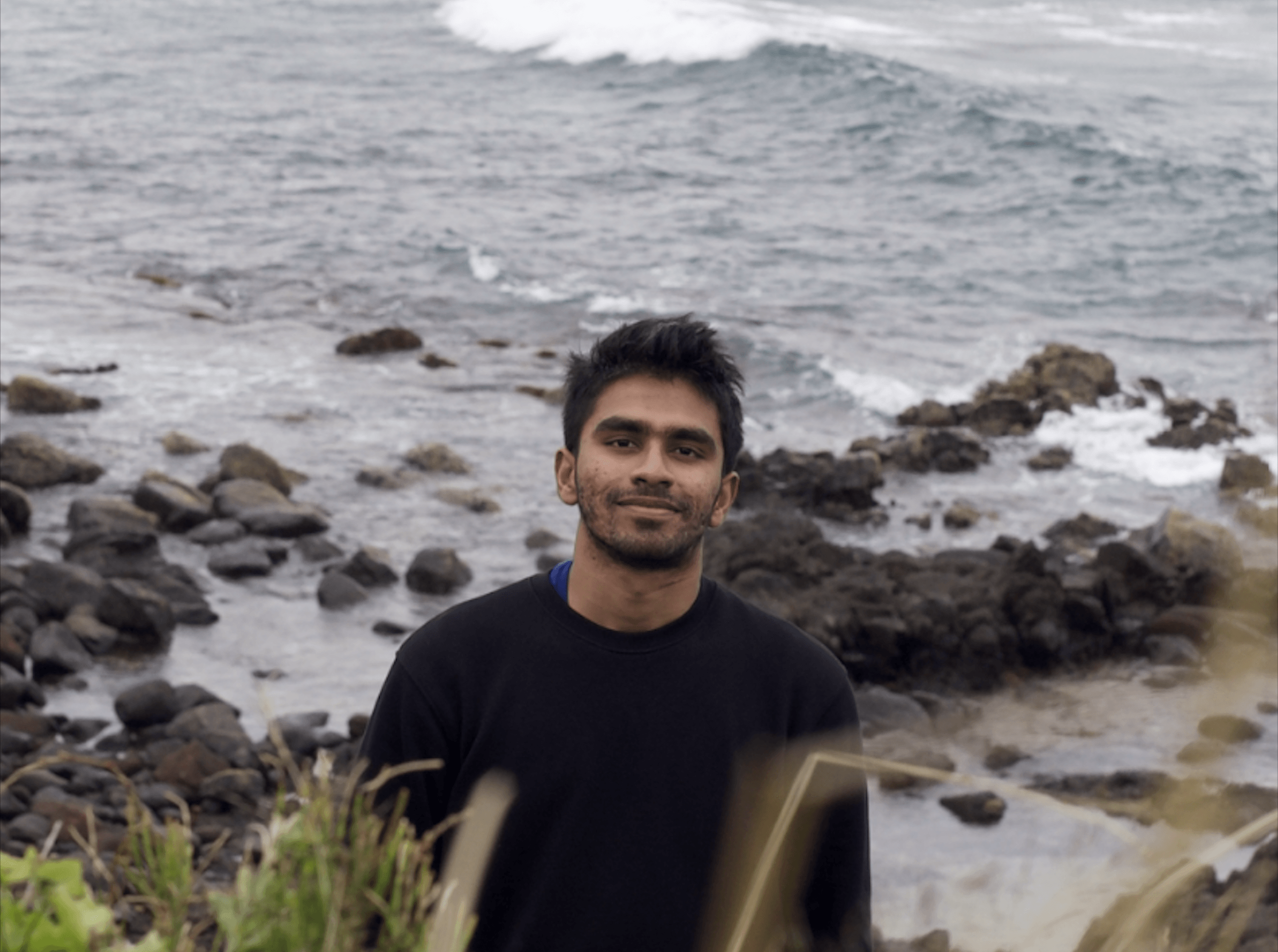
Hi!I'm Thenuja

Computer Engineering (Honours) graduate from UNSW who likes building across the stack, from FPGA pipelines and virtual memory to containerised services, agentic AI systems and AI agents.

experience

Jul 2026Present

Research Assistant

UNSW
  1. 01Maintain the AWS deployment of UniVise, the university-funded AI planning platform I built as my honours thesis, diagnosing runtime errors and shipping fixes for its student test users.
  2. 02First author on a symposium submission to the AARE Conference 2026, coordinating with external institutional stakeholders.
  3. 03Designing an end-to-end usability study covering participant recruitment, survey design, data collection and analysis, feeding findings into the platform roadmap.
  4. 04Deliver statistical and budget reporting for the research team by running analytics over research databases and platform records.

education

UNSW Sydney

Bachelor of Engineering (Honours)

Computer Engineering

My time at university was a journey through the entire computing stack. I started with circuits and signals, moved through logic, processors and operating systems, then finished by building software and intelligent systems.

Explore my coursework, one layer at a time.

Electricity
DATAANDORXORPOWERCPURAMSSD

Electricity

Voltage and current are the raw material. Before a machine can represent a single bit, power has to move predictably through wires, resistors, capacitors and semiconductor devices.

  • Electricity. Voltage and current are the raw material. Before a machine can represent a single bit, power has to move predictably through wires, resistors, capacitors and semiconductor devices. ELEC1111 Electrical Circuit Fundamentals. Analysed DC and AC networks using circuit laws, equivalent models and transient response.. PHYS1121 / PHYS1221 Physics 1A and 1B. Built the physical model for charge, fields, energy and waves beneath electronic systems.
  • Signals. Real voltages are noisy and continuous. Analogue circuitry amplifies, filters and samples them until hardware can distinguish a dependable pulse from interference. ELEC2133 Analogue Electronics. Designed transistor and operational-amplifier circuits that condition real electrical signals.. ELEC2134 Circuits and Signals. Represented signals in time and frequency, then analysed how systems transform them.
  • Logic. Stable pulses become zero and one. Gates combine those bits into arithmetic, decisions and clocked state—the first point where electricity starts behaving like computation. COMP3222 Digital Circuits and Systems. Built combinational and sequential circuits from gates, registers and finite-state machines.. COMP3222 Digital Circuits and Systems. Used Boolean algebra and binary arithmetic to turn truth tables into working hardware.
  • Chip design. Those logic blocks become a hardware architecture. I described parallel circuits in VHDL, simulated their timing, then synthesised them onto reconfigurable FPGA silicon. COMP3601 / COMP4601 Design Project A and B. Designed, simulated and deployed complete VHDL systems on FPGA development boards.. COMP6420 Hardware Security. Examined how physical implementations leak information—and how trust can begin in silicon.
  • Processor. A processor coordinates registers, arithmetic units, pipelines, caches and memory. It repeatedly fetches, decodes and executes instructions while hiding enormous hardware complexity. COMP3211 Computer Architecture. Worked with datapaths, instruction pipelines, caches, hazards and memory hierarchies.. COMP1521 Computer Systems Fundamentals. Used C and assembly to understand instructions, data representation and memory at machine level.
  • Operating system. The operating system turns one physical computer into a safe platform for many programs. It schedules processes, isolates memory and provides controlled access to files and devices. COMP3231 Operating Systems. Implemented kernel concepts including processes, system calls, virtual memory and file systems.
  • Data. Useful software needs information to survive after a process ends. Data structures organise it in memory; databases preserve, relate and retrieve it reliably at larger scale. COMP3311 Database Systems. Modelled relational data and wrote queries, constraints and transactions for reliable persistence.. COMP2521 Data Structures and Algorithms. Selected and implemented structures whose time and space costs fit the problem being solved.
  • Programs. Languages and software abstractions let people express intent without manually controlling every register. Structure, testing and collaboration turn that code into maintainable systems. COMP1511 Programming Fundamentals. Learned structured problem-solving and implemented programs in C from first principles.. COMP1531 Software Engineering Fundamentals. Built tested software collaboratively using APIs, version control and iterative delivery.. COMP2511 Object-Oriented Design and Programming. Applied design principles and patterns to keep larger codebases understandable and adaptable.
  • Intelligence. Some programs learn a useful representation from examples instead of receiving every rule directly. Training, evaluation and interpretation turn data into models that can generalise. COMP9444 Neural Networks and Deep Learning. Designed and evaluated learned models across optimisation, classification and sequence problems.. COMP9517 Computer Vision. Built systems that extract features, detect objects and interpret visual scenes.. COMP4951 / 4952 / 4953 Research Thesis A, B and C. Designed, built and evaluated UniVise as an end-to-end research and engineering project.
  • You. The final layer is a person with a goal. Every abstraction below succeeds only when the interface makes all that complexity useful, understandable and trustworthy. COMP3511 Human-Computer Interaction. Used research and prototyping to design around real human needs, limits and behaviour.. DESN1000 / DESN2000 Engineering Design. Balanced technical constraints, user outcomes and team decisions through iterative design.

software

S01

Subtrack

An agentic personal-finance platform that finds your subscriptions in Gmail receipts and tracks what they actually cost. A hand-rolled LLM tool-calling loop drives 11 custom tools, with explicit user confirmation and server-side ownership re-checks before any database mutation.

Next.js · FastAPI · PostgreSQL · Claude API

S02

UniVise

My honours thesis, awarded High Distinction and selected for the UNSW CSE Thesis Showcase 2025. An AI academic and career planning platform for UNSW students: 10,000+ handbook and job-listing records structured through async Python pipelines, LLM response time cut 40% by parallelising API calls, and infrastructure cost cut 48% by migrating off ECS Fargate.

FastAPI · React · PostgreSQL · AWS

More projects

hardware

H01

FPGA Bitcoin Miner

A pipelined Keccak/SHA-3 hashing core in VHDL implementing all five Keccak-f permutation stages, with an FSM-driven miner control layer and an AXI-Lite interface exposing miner registers to the ARM Cortex-A53 host on the Kria KV260. Validated against known Keccak test vectors in simulation and on hardware.

VHDL · Kria KV260 · AXI-Lite

H02

AVR Elevator Simulator

A multi-floor elevator controller written in AVR assembly on the ATmega2560, interfacing keypad, LCD/LED, PWM motor control and external interrupts, with FSM logic for motion, door control and emergency stops.

AVR Assembly · ATmega2560

More projects

everything on github ↗